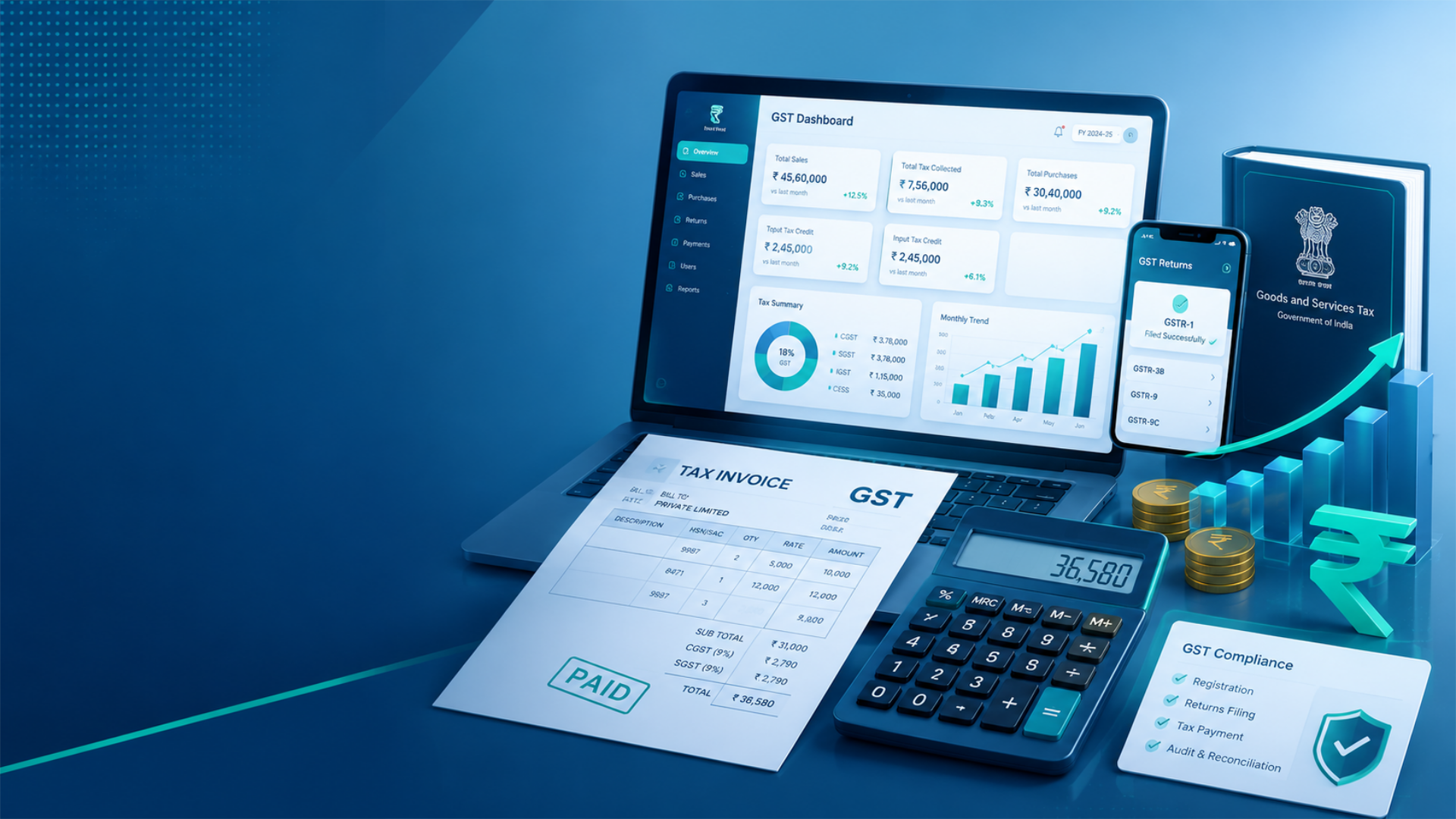
GST registration gives a business a GSTIN - a 15-digit Goods and Services Tax Identification Number - and the right to collect tax, claim Input Tax Credit, and supply goods or services legally in the GST framework. The registration thresholds and mandatory categories remain the same in 2026 as they were in 2023, but new compliance layers - including e-invoicing and the QRMP scheme - apply depending on your turnover. This checklist tells you who needs to register, what documents are required, and how to apply.
Mandatory GST Registration Thresholds & Criteria (2026 Guidelines)
Under Section 22 of the Central Goods and Services Tax Act, 2017 (CGST Act), the following turnover thresholds apply and are unchanged in 2026:
- Goods suppliers - mandatory registration if aggregate annual turnover exceeds Rs. 40 lakh. For businesses in special category states (Manipur, Mizoram, Tripura, Nagaland), the threshold is Rs. 20 lakh.
- Service providers - mandatory registration if aggregate annual turnover exceeds Rs. 20 lakh. The threshold is Rs. 10 lakh for special category states.
The following businesses must register regardless of turnover (Section 24, CGST Act):
- Persons making inter-state taxable supply of goods or services.
- Casual taxable persons supplying in a state where they have no fixed place of business.
- Input Service Distributors.
- E-commerce operators and suppliers through e-commerce platforms.
- Persons required to pay tax under the reverse charge mechanism.
- Persons supplying online information and database access or retrieval (OIDAR) services from outside India to persons in India.
- Persons supplying online money gaming from outside India (added vide CGST Amendment Act, 2023).
Need help with GST registration?
Get expert-led GST registration, filing, and compliance assistance without delays.
Talk to GST ExpertNew E-Invoicing Compliance Mandates for B2B Transactions
As of 2026, e-invoicing is mandatory for all B2B transactions (and certain B2C and export transactions) for businesses with Aggregate Annual Turnover (AATO) of Rs. 5 crore and above, as per GST Notification 10/2023 (effective 1 August 2023). After getting your GSTIN, if your turnover crosses this threshold, you must register on an Invoice Registration Portal (IRP) and obtain an Invoice Reference Number (IRN) for each B2B invoice. The GSTN portal auto-enables businesses crossing this threshold.
GST Documentation Checklist for Private Limited Companies
As per the GST portal document advisory (gst.gov.in/docadvisor), the following documents are required:
- PAN card of the company.
- Certificate of Incorporation issued by MCA.
- Memorandum of Association (MOA) and Articles of Association (AOA).
- PAN card and Aadhaar of all directors.
- Proof of registered office address : electricity bill (not older than 2 months), rent agreement, or NOC from owner.
- Bank account details : cancelled cheque or bank statement.
- Digital Signature Certificate (DSC) of the authorised signatory.
- Board resolution authorising the signatory, if not a director.
Step-by-Step GSTIN Application Process on gst.gov.in
- Part A : Enter PAN, email ID, and mobile number. Verify via OTP. A Temporary Reference Number (TRN) is generated.
- Part B : Log in with TRN. Fill in business name, address, type, promoter/director details, authorised signatory, principal and additional places of business, and goods/services dealt in.
- Submit with DSC (mandatory for companies and LLPs) or EVC for other entities.
- GSTIN is issued within 3 to 7 working days if documents are in order. The officer may raise a query in Form GST REG-03.
Need help with GST registration?
Get expert-led GST registration, filing, and compliance assistance without delays.
Talk to GST ExpertQRMP Scheme Benefits for Small Businesses under Rs. 5 Crore
Taxpayers with aggregate annual turnover up to Rs. 5 crore can opt for the Quarterly Return Monthly Payment (QRMP) scheme filing GSTR-1 quarterly while paying tax monthly. This reduces the annual number of GST return filings significantly.
How Targolegal can help
Targo Legal prepares and files your GST REG-01 application and follows up until your GSTIN is issued. We also advise on e-invoicing setup, QRMP scheme eligibility, and GST compliance structure for your business type.
